

Final Carbon Reduction Case Study
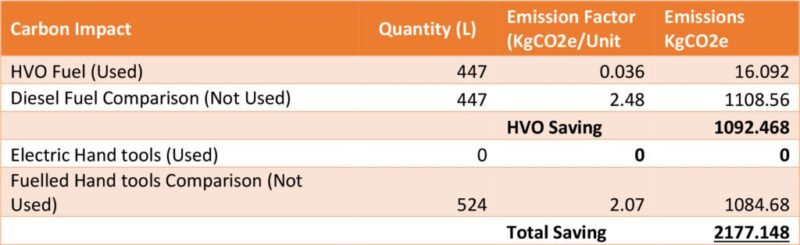
Previously we identified that emissions from our plant and vehicles represented a key challenge and one of our most significant carbon impacts. To address this and improve our carbon footprint, we undertook a comparative exercise to assess the compatibility of hydrotreated vegetable oil (HVO) biofuel with our assets. Initial calculations indicated that switching to HVO could reduce our carbon emissions by more than 98%.
Working closely with National Highways, and in alignment with our Net Zero Strategy — supporting our Whole Life and Boundary Approach and Deliver Schemes Process — we implemented a Carbon Reduction Trial across the M57 and M58 Sightline Schemes. By adopting the ‘Avoid, Switch, Improve’ carbon reduction hierarchy, we achieved measurable and meaningful environmental benefits.
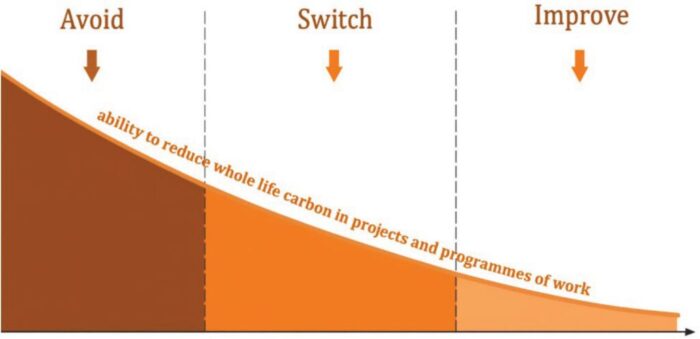
NOTE: This figure represents a simplified and streamlined version of the carbon reduction hierarchy presented in PAS 2080:2016 and the Infrastructure Carbon Review (ICR). It has been updated to clarify its applicability and relevance to a wider range of projects and programmes within the built environment (i.e. to clarify that the carbon reduction hierarchy is not solely about new builds).
Carbon Reduction Measures
During the M57 and M58 Sightlines project delivery, we replaced diesel fuel with HVO biofuel across all compatible plant and machinery. Additionally, we eliminated the need for fuel-powered hand tools by switching to battery-operated alternatives, further reducing emissions and improving operational sustainability.
Carbon Savings Achieved
The carbon emission savings from using 447 litres of HVO biofuel totalled 1,092.468 kgCO₂e. Combined with the estimated fuel savings achieved from the use of battery-operated hand tools, we recorded a total reduction of 2,177.148 kgCO₂e

Carbon Data
Carbon Impact Comparison
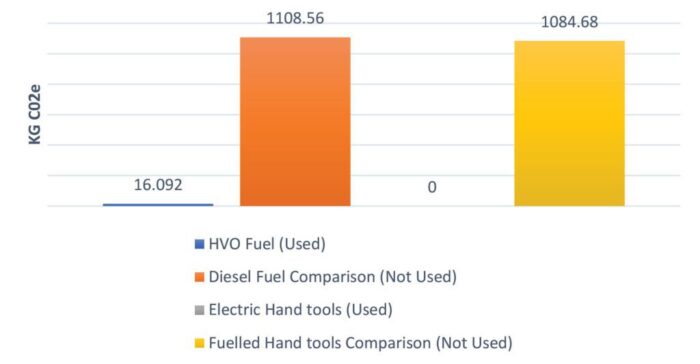
These savings demonstrate the significant positive impact of low-carbon fuels and electrified equipment on scheme-level emissions.
Further Benefits – Reduced HAV Exposure
In addition to carbon reduction, the scheme also improved operative wellbeing by reducing hand–arm vibration exposure. A review of HAVS submissions highlighted notable reductions in total exposure points when using battery-powered equipment. Throughout the scheme, a total of 5,136 minutes were logged for hand tool usage.
HAV Points Comparison

The data confirms that battery-operated hand tools are both environmentally advantageous and significantly safer in reducing vibration risks associated with prolonged tool use.
Looking Ahead
As part of our ongoing commitment to Net Zero by 2040, GVA looks forward to deploying our new all-electric panel van, which will further enhance our ability to deliver carbon-efficient landscape and ecology works. Fully equipped with electric hand tools, this vehicle will help expand low-emission capabilities across future projects.
Testimonial
“National Highways Carbon Management System (CMS) was first published in 2022 to align with PAS 2080:2016 and is a key enabler for our Net Zero Plan. The CMS is a framework of processes that will help us consider and reduce carbon at every stage of a project’s lifecycle. Hydrotreated vegetable oil is a construction opportunity in National Highways Low Carbon Opportunities Register as CNS-124. The work by GVA will be a key case study to support HVO opportunities in future schemes at National Highways.”
Betty Wilson – National Highways Project Manager, Operations Northwest